Understanding Facebook’s Advertising Ecosystem
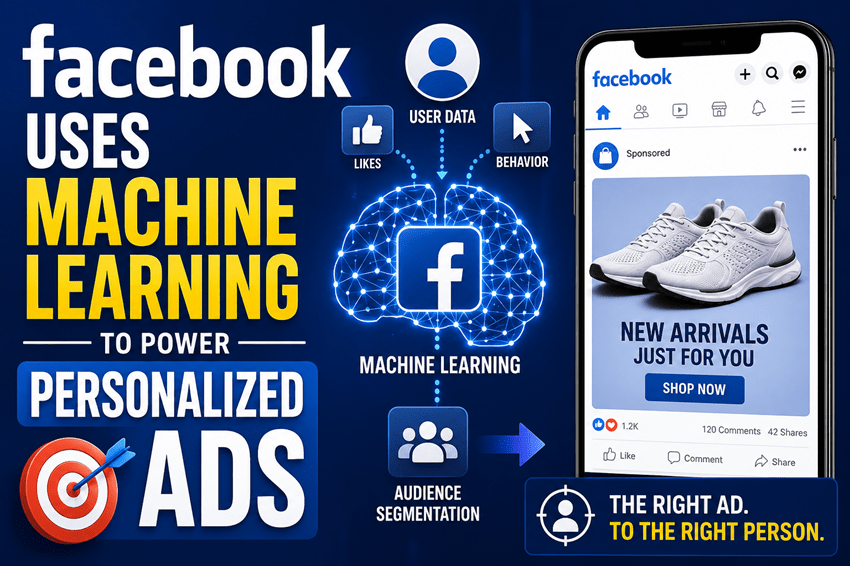
Facebook, now under the Meta umbrella, manages one of the most sophisticated advertising platforms in the digital world. With over 3 billion users globally, the scale and depth of user interactions provide a fertile ground for highly personalized ad targeting. At the heart of this system is machine learning (ML) — a powerful set of algorithms designed to analyze vast datasets, predict user preferences, and serve ads that are uniquely relevant.
Massive Data Collection: The Foundation of Personalization
Every user interaction on Facebook, from liking a post to pausing on a video, becomes a data point. These interactions are continuously collected and stored, forming a rich behavioral profile for each user. This includes:
- Demographic details (age, gender, location)
- Device usage and browsing patterns
- In-app behavior (likes, shares, comments, reactions)
-
Off-platform activity via Facebook Pixel and APIs
- Interests derived from pages followed and content consumed
Machine learning models process this data in real time to generate dynamic, evolving user profiles. These profiles are crucial in predicting what types of ads a user is most likely to engage with.
Facebook’s Machine Learning Frameworks
To execute hyper-targeted advertising at scale, Facebook leverages multiple proprietary machine learning frameworks:
1. FBLearner Flow
FBLearner Flow is Facebook’s internal ML-as-a-service platform. It allows engineers and data scientists to:
-
Build custom ML models
- Train models on massive datasets
- Automatically update them based on performance
- Deploy them seamlessly across Facebook’s infrastructure
This platform supports models for everything from content ranking to ad optimization.
2. DeepText and DeepFace
Facebook uses DeepText, a deep learning model, to analyze and understand text input at near-human levels. It helps decipher user sentiment, identify spam, and understand context in multiple languages.
Meanwhile, DeepFace, a facial recognition system, improves ad targeting based on photos users upload, interact with, or are tagged in. It refines demographic estimation and visual content understanding.
3. PyTorch and Custom Architectures
Facebook has been a strong advocate and contributor to PyTorch, an open-source deep learning framework. With PyTorch, Meta engineers create flexible neural network architectures that power complex models for:
-
Ad ranking
- Conversion prediction
- Click-through-rate (CTR) optimization
- Engagement forecasting,
Real-Time Bidding and Ad Auction Algorithms
Facebook’s ad delivery system operates on a real-time auction model, where advertisers bid for user impressions. Machine learning algorithms optimize this system by:
-
Predicting the likelihood of conversion
- Evaluating ad quality and relevance score
- Balancing advertiser bid value and user experience
The auction engine selects the most relevant and highest-performing ad to display. It’s not just about the highest bid — it’s about the highest expected value for both users and advertisers.
Lookalike Audiences and Predictive Targeting
Facebook enables businesses to create lookalike audiences, a feature powered by advanced machine learning classification and clustering algorithms. These models analyze seed audiences (existing customers) and find new users who resemble them in:
-
Behavioral traits
- Online activity patterns
- Interests and intent signals
This results in an extended yet highly targeted audience, increasing the potential ROI for advertisers
Ad Ranking with Multi-Objective Optimization
The ad ranking algorithm uses multi-objective optimization to weigh several factors simultaneously:
- Predicted engagement (likes, comments, clicks)
- Ad relevance
- User satisfaction score
- Platform policy compliance<,/li>
Facebook uses reinforcement learning models to continuously adjust these weights based on ongoing outcomes. The system learns over time which ads lead to better experiences for users and higher returns for advertisers.
Conversion Prediction and Attribution Modeling
Predicting whether a user will complete an action after seeing an ad — like purchasing a product or signing up — is central to Facebook’s ad system. This is done through conversion prediction models that analyze:
-
Historical user behavior
- Cross-device interactions
- Funnel depth and bounce rates
Facebook also uses multi-touch attribution models to assign appropriate credit to ads that contribute to conversions. This informs future ad delivery and budget allocation.
Dynamic Creative Optimization (DCO)
Machine learning also powers Dynamic Creative Optimization, where Facebook automatically assembles ad creatives from components such as:
- Images and videos
- Headlines and copy
- CTAs (Call-To-Actions)
Algorithms test different combinations with different audience segments, continuously optimizing based on real-time engagement and performance data.
Dynamic Creative Optimization (DCO)
Machine learning also powers Dynamic Creative Optimization, where Facebook automatically assembles ad creatives from components such as:
- Images and videos
- Headlines and copy
- CTAs (Call-To-Actions)
Algorithms test different combinations with different audience segments, continuously optimizing based on real-time engagement and performance data.
User Privacy and Federated Learning
With growing concerns over data privacy, Facebook has incorporated federated learning into its ecosystem. This approach allows models to train directly on users’ devices, ensuring personal data never leaves the device. Only anonymized updates are shared with the central model.
This method balances data privacy with personalization, reinforcing Facebook’s commitment to ethical AI and compliance with regulations like GDPR and CCPA.
Continuous Learning and Model Updating
The digital landscape and user behavior shift rapidly. Facebook’s machine learning systems are built to adapt in real time. With each new data point, the models:
-
Reassess ad targeting strategies
- Refine audience segmentation
- Improve conversion predictions
- Update relevance scores
This continuous learning loop ensures that ads stay contextually relevant and impactful over time.
Why Facebook’s ML-Powered Ads Deliver Unmatched ROI
When compared to other platforms, Facebook’s use of machine learning delivers unparalleled return on investment due to:
- Granular targeting based on real-time user behavior
- Predictive analytics for smarter ad placement
- Scalable personalization at the individual user level
- Advanced fraud detection and ad quality filters
This enables businesses of all sizes to compete effectively and reach potential customers with precision and efficiency.